
















The Epidemiology of Loneliness: What the Data Actually Shows
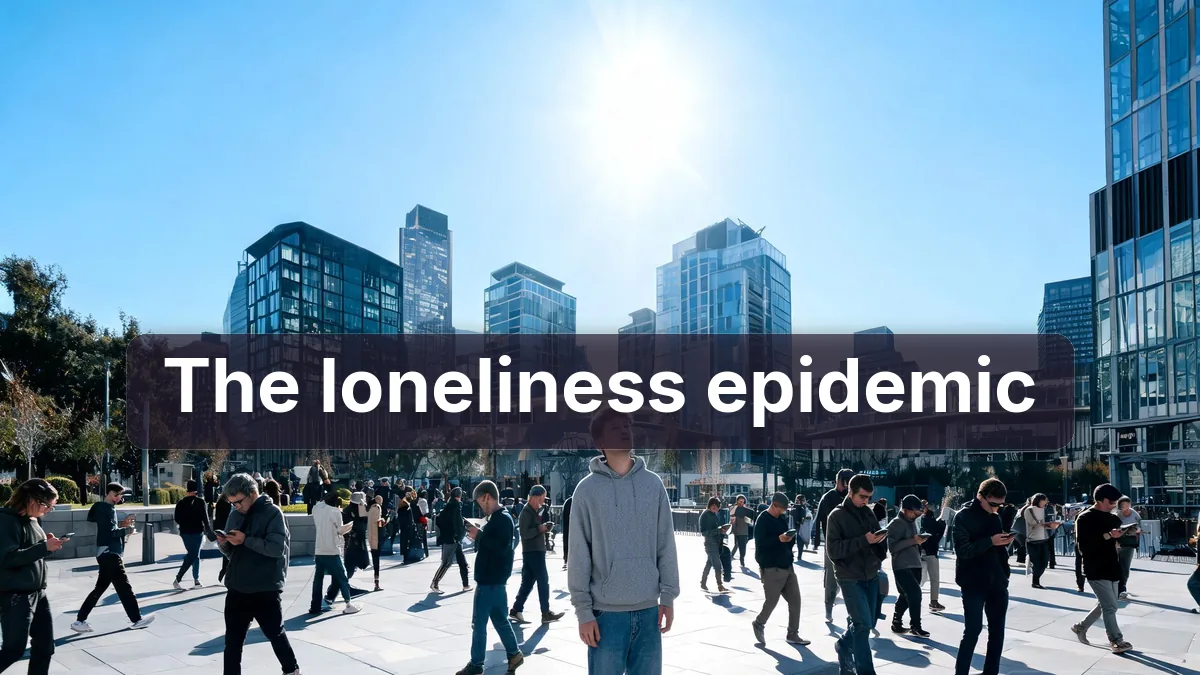
Loneliness has reached the threshold of a documented public health crisis. In 2023, US Surgeon General Dr. Vivek Murthy issued a formal advisory - the first of its kind - declaring loneliness and social isolation an epidemic with health consequences comparable to smoking 15 cigarettes per day. The advisory cited data showing approximately half of American adults reporting measurable loneliness, and called for a national strategy addressing the structural, technological, and cultural drivers of social disconnection.
The UK appointed a Minister for Loneliness in 2018 following the Jo Cox Commission's finding that over nine million British adults were often or always lonely. Australia has produced similar data. These are not soft cultural observations - they are findings from nationally representative surveys using validated instruments such as the UCLA Loneliness Scale, which has been the field standard for measurement since its development by Daniel Russell in 1978 and revision in 1996.
The full statistical landscape, including breakdowns by age, gender, country, and setting: Loneliness Facts: Key Statistics, Causes and Health Impacts and The Loneliness Epidemic.
The Neuroscience and Physiology: Why Loneliness Harms the Body
The 2015 meta-analysis by Julianne Holt-Lunstad, Timothy Smith, and colleagues - reviewing 70 studies involving over 3.4 million participants - found that social isolation and loneliness increased the odds of early mortality by 26% and 29% respectively. These are not marginal findings. The mechanisms are physiological and well-understood: chronic loneliness activates the hypothalamic-pituitary-adrenal (HPA) axis, elevating cortisol and adrenaline. Sustained activation of this stress system produces measurable downstream effects - increased systemic inflammation, impaired immune function, disrupted sleep architecture, and accelerated cellular ageing via telomere shortening.
The late University of Chicago neuroscientist John Cacioppo, who spent three decades studying loneliness, identified what he called the hypervigilance hypothesis: lonely individuals shift unconsciously into a threat-detection mode in social situations, interpreting ambiguous signals negatively, withdrawing from social risk, and thereby perpetuating the very isolation that causes their distress. This self-reinforcing cycle is why chronic loneliness is so resistant to simple interventions like "just put yourself out there."
For the physiological detail: Loneliness Symptoms: Physical and Psychological Signs and Loneliness and Depression: What the Research Really Shows.
Who Loneliness Actually Affects - and Why the Data Surprises People
The common assumption that loneliness primarily affects the elderly is consistently contradicted by large-scale data. Cigna's 2020 US Loneliness Index (n=10,000+) found Generation Z adults (18–22) to be the loneliest cohort measured, with a mean score of 65.7 on the UCLA Loneliness Scale - compared to 50.2 for adults over 72. A 2020 Harvard Graduate School of Education report found 61% of young adults reporting serious loneliness. These findings have been replicated across multiple countries and methodologies.
The drivers of young adult loneliness are structurally different from elderly loneliness: they include the loss of the social scaffolding provided by education, economic instability limiting social participation, digital communication substituting for in-person contact, and a cultural context in which men in particular are given few socially sanctioned avenues to express or address emotional need. Workplace loneliness is a separate and growing concern - a significant proportion of working adults report no close friendships at work, a figure that has worsened over the past decade.
Specific contexts: Loneliness Among Students, Lonely at Work, Loneliness After a Breakup, How to Deal with Loneliness as a Man.
A Taxonomy of Loneliness - Why Distinctions Matter for Treatment
Robert Weiss's foundational 1973 work distinguished between social loneliness (the absence of a satisfying social network) and emotional loneliness (the absence of a close, intimate attachment figure). These are not interchangeable: someone can have many acquaintances and still suffer emotional loneliness; someone can be socially isolated and not suffer loneliness if their need for attachment is met by a small number of close relationships. Interventions that address one type often have little effect on the other.
The further distinction between situational and chronic loneliness is clinically important. Situational loneliness - triggered by bereavement, relocation, relationship breakdown, or transition - typically resolves as circumstances change, and requires different support than chronic loneliness, which persists across situations and indicates a deeper pattern of social cognition, avoidance, or structural disadvantage. Treating these as the same condition produces poor outcomes.
Conceptual guides: Loneliness vs. Solitude, Loneliness vs. Isolation, Loneliness vs. Depression, What Loneliness Actually Means.
What the Evidence Says About Reducing Loneliness
A 2020 systematic review by Hickin et al. (38 studies, diverse populations) found that psychological interventions targeting maladaptive social cognitions - particularly CBT-based approaches developed from Cacioppo's model - produced the largest and most durable reductions in loneliness. Pure social contact interventions (meetups, group activities) had smaller effects, especially for chronic loneliness where the cognitive pattern of negative social interpretation maintains the condition regardless of contact frequency. Social skills training had moderate evidence support; online social interventions had weak and inconsistent evidence.
The practical implication is that people with chronic loneliness generally need more than increased social exposure. They need support in changing how they interpret and engage with social situations - which is why self-help advice to "just go out more" often fails. For situational loneliness, by contrast, the evidence for environmental and behavioural changes is stronger, because the maintaining factor is circumstance rather than cognition.
Practical guidance: Loneliness Cure: Why There's No Single Fix, Dealing with Loneliness, How to Overcome Loneliness Without Friends.
Our Approach to Loneliness Coverage
Our loneliness articles are written and reviewed by Jack Taylor, Ph.D., whose work draws on clinical psychology, public health research, and first-person reporting. We distinguish carefully between clinical and colloquial uses of the term, cite primary sources rather than secondary summaries where possible, and flag the limitations of studies we reference - including sample size, methodology, and generalisability.
We cover AI companionship as a potential partial response to loneliness, but we do not promote it as a solution. The evidence on AI companions and loneliness is early-stage, methodologically limited, and genuinely uncertain. We report what the studies show, including their limitations, and leave conclusions to the reader. Our goal is to be the most accurate and honest source on this topic available online - not the most reassuring one.
A note on mental health support: If you are experiencing severe or persistent loneliness, depression, or related distress, please consider speaking with a qualified mental health professional. In the US, you can contact the SAMHSA National Helpline (free, confidential, 24/7) at 1-800-662-4357. The content on this page is educational and does not constitute clinical advice.