
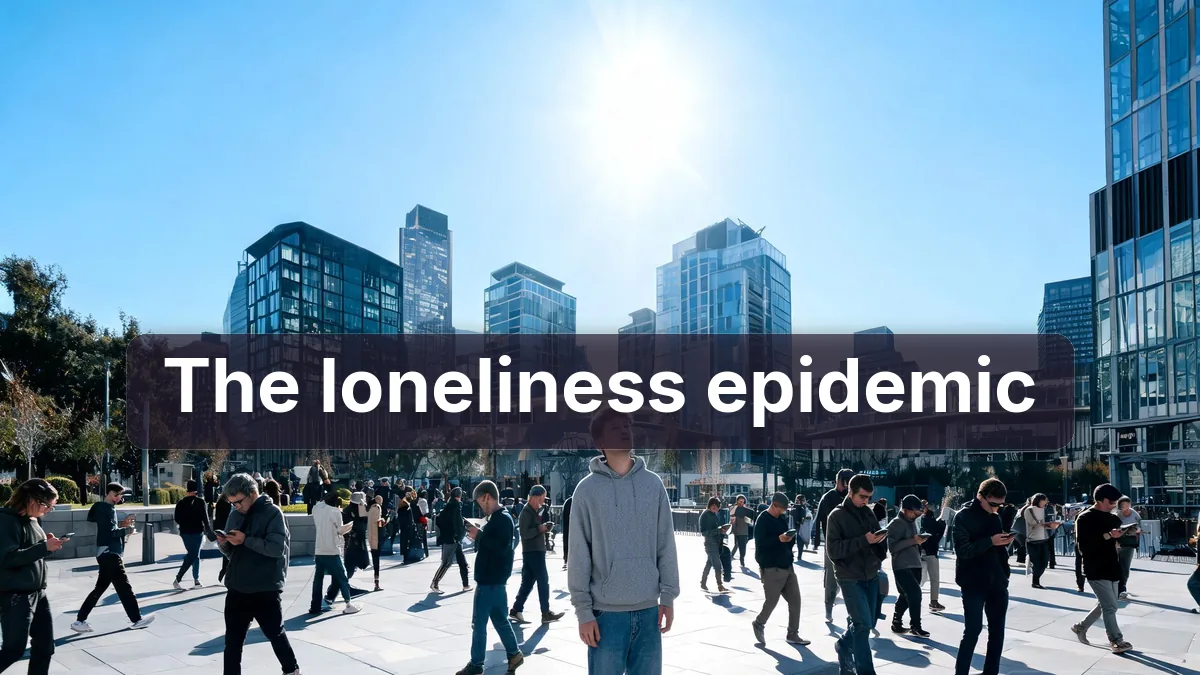
The loneliness epidemic describes a decades-long decline in social connection now recognized as a formal public health crisis by the US Surgeon General, the World Health Organization, and governments in the UK, Japan, and Australia. It is not just about being physically alone, but about the widespread feeling of being cut off from others. Its effects on health can be as serious as smoking or obesity.
Millions of people experience this every day, often without anyone noticing. That is why it is so important to understand what is causing it, who is most at risk, and what we can do to reconnect.
Key Takeaways
- Loneliness is widespread and affects people of all ages, not just those who are alone.
- The loneliness epidemic has serious impacts on both mental and physical health.
- Young adults, seniors, caregivers, and remote workers are among the most at risk.
- Modern factors like technology, social media, and changing lifestyles are fueling disconnection.
- Small steps, both personal and community-based, can make a big difference in fighting loneliness.
Loneliness Epidemic in the US
In 2023, the US Surgeon General issued a formal advisory calling loneliness an urgent public health crisis. The data was stark:
- More than half of all US adults say they feel lonely regularly.
- One in three adults aged 45 and older feels socially isolated.
- Among young adults aged 18 to 24, nearly 80% say they have felt lonely at some point.
The advisory identified five structural causes: reduced investment in public spaces and civic life, overwork, excessive digital engagement replacing in-person contact, high residential mobility weakening community ties, and declining participation in religious, union, and neighborhood organizations. These are not individual failures. They are systemic conditions.
While COVID-19 intensified these feelings, loneliness was already rising well before it. Understanding the structural roots helps explain why building real connections, and the systems that support them, matters so much.
Who Is Most Affected by the Loneliness Epidemic?
Loneliness can happen to anyone, but some groups are consistently more vulnerable:
- Young adults (18 to 24) report the highest loneliness rates of any age group, even while constantly connected online.
- Seniors who live alone or in care facilities often feel forgotten or left behind.
- New parents and caregivers face demanding, isolating roles that leave little room for their own social needs.
- Remote workers lose the casual daily contact that offices naturally provide.
- People with chronic illness or disability face additional barriers to social participation.
And while social media promises connection, time spent online without meaningful interaction can actually deepen the feeling of being alone.
How It Feels to Be Lonely
Loneliness often goes unnoticed because people who feel it still go about their daily lives. They go to work, spend time with others, and even smile, but inside, loneliness creates a heavy feeling of emptiness, like something important is missing.
Even when surrounded by people, lonely individuals can feel completely disconnected, as if no one truly sees or understands them.

The Emotional Impact
Chronic loneliness can make people feel they are not worth attention or care. Over time, it traps them in a cycle where reaching out feels too hard, so they withdraw further. It erodes confidence and makes social situations feel exhausting, even when they genuinely want to connect.
What Science Says
Research from UC Berkeley shows that loneliness activates the brain's threat response, making social pain feel stronger and emotional regulation harder. This helps explain why loneliness can be so difficult to break out of on your own, and why it requires more than willpower to address.
Leading Causes of Loneliness
Loneliness rarely has a single cause. It tends to build from a mix of changes in how we live, work, and connect, some personal, others structural and embedded in modern society.
1. Technology and Social Media
Digital tools help us stay in touch, but they have also changed what "connection" looks like. A quick like or a brief message often replaces a real conversation, and those shallow exchanges leave people craving something deeper.
Social media also tends to show only the highlights of others' lives, which can make people feel like they are falling behind or missing out, even when they are not.
Some people are exploring alternatives like an AI girlfriend as a way to experience emotional connection online. For a broader view of how AI and loneliness intersect, see our piece on AI and loneliness.
2. Remote Work and Changing Work Culture
Working from home eliminates the casual daily interactions that offices naturally generate: a quick chat by the coffee machine, a shared lunch, a spontaneous conversation in the hallway.
Without those small moments, even a busy, productive day can leave people feeling surprisingly isolated.
3. Urbanization and Living Alone
More people than ever live alone, especially in cities. Independence is valuable, but it also means fewer daily interactions built into life by default.
In dense urban areas, people can be surrounded by neighbors they have never spoken to. Physical proximity and genuine social connection are not the same thing.
4. Decline in Community Engagement
Clubs, religious groups, and local events once played a central role in bringing people together. Participation in these spaces has declined sharply over the past few decades.
Busy schedules, frequent moves, and long commutes make it harder to build the sustained, place-based relationships that strong communities depend on.
5. Life Transitions
Major changes shake up existing social networks. Moving cities, going through a breakup, retiring, or losing a job can leave a person feeling unmoored. Even something as positive as becoming a new parent can bring unexpected isolation when familiar routines and relationships shift overnight.
How Loneliness Affects Us
Loneliness is not just an emotion. It has real, measurable effects on the body, the mind, and even the broader economy.

Mental Health Effects
Loneliness is strongly linked to depression and anxiety. When isolation persists, it feeds negative thought patterns, low self-esteem, and the sense that no one truly understands you.
In older adults, long-term loneliness has also been connected to a higher risk of cognitive decline and dementia.
Physical Health Effects
The body responds to chronic loneliness much as it does to physical illness. People who feel persistently lonely face higher risks of heart disease, stroke, weakened immune function, chronic inflammation, and poor sleep.
The cumulative effect on overall wellbeing is substantial, and often goes unrecognized until it becomes serious.
Social and Economic Impact
Disconnected people often struggle with motivation, focus, and productivity at work. Loneliness is also linked to greater healthcare use and higher rates of substance use as a way of coping.
Across the US economy, the costs of loneliness in lost productivity and increased healthcare spending are estimated at between $2 billion and $25 billion annually.
Small Steps to Fight the Loneliness Epidemic
Even in the middle of an epidemic, there are practical ways to ease loneliness, for yourself and for the people around you. The most lasting changes often start small.

What You Can Do Personally
Reach out to someone, even if it feels hard to be the one who starts. A message, a call, or a coffee date can break the cycle. Connection rarely starts on its own.
Join a group built around something you enjoy: a fitness class, a local club, a volunteer role. When the activity is the reason you are there, meeting people feels natural rather than forced.
Be mindful of passive screen time. Scrolling without purpose tends to make loneliness worse, not better. Swap some of that time for voice messages, video calls, or thoughtful replies that actually move a relationship forward.
If loneliness is weighing on your mental health, talking to a therapist is a real option. You do not have to manage it alone.
How Communities and Organizations Can Help
Communities thrive when people feel they belong. Support circles, peer groups, and shared activities give people a reason to show up and a space to feel seen.
For organizations with remote teams, building in time for casual check-ins, shared lunches, or conversations that go beyond tasks can make a significant difference in how connected people feel day to day.
What Policymakers Can Consider
Loneliness is a public health issue, and addressing it at scale requires policy. That means funding programs that support those most at risk, including older adults, caregivers, and young people, and building emotional literacy into education so people grow up with better tools for connection.
As technology advances, emotional AI is being explored as a tool to support wellbeing, especially for those with limited access to in-person support.
Conclusion: What We Can Do, Together
The loneliness epidemic is real, and it is affecting more people than most of us realize. But it is not inevitable, and it does not mean something is wrong with you. It means you are human.
Small efforts to connect, communities that make belonging easier, and policies that take isolation seriously: all of it adds up. Every conversation, every message, every kind gesture moves things in the right direction.
If you are looking for a safe space to connect and feel less alone, an AI girlfriend can offer compassionate conversation anytime.
Frequently Asked Questions
Is loneliness actually an epidemic?
The evidence supports the label. Loneliness rates have risen substantially over several decades, now affect a majority of adults in some surveys, and produce health consequences comparable in scale to obesity and the opioid crisis. The US Surgeon General's 2023 formal advisory, the same mechanism used to declare those earlier epidemics, signals the evidence has crossed that threshold.
What country has the highest loneliness rate?
Cross-country comparisons are complicated by different measurement tools and cultural differences in willingness to report loneliness. By most available metrics, the United States, United Kingdom, Brazil, and Australia show among the highest rates in the developed world. Countries with consistently lower rates tend to share strong civic participation culture, robust public social infrastructure, and shorter working hours.
Why are young people lonelier now?
Young adults (18 to 25) now report higher loneliness rates than any other age group, the opposite of what most people expect. The likely causes include smartphone-mediated contact replacing in-person engagement during the years when friendships form most naturally, delayed family formation, economic instability limiting residential stability, and declining participation in the civic and community institutions that historically provided belonging.
What can fix the loneliness epidemic?
Both structural and individual responses are needed. At the structural level: investment in public spaces, social prescribing programs, workplace culture changes, and policies that support stable residential communities. At the individual level: behavioral activation, community involvement, and deliberate investment in relationship depth. Tools like AIGirlfriends.ai can serve as bridges toward human connection rather than substitutes for it. No single intervention solves a structural epidemic; the response needs to match the scale of the cause.