
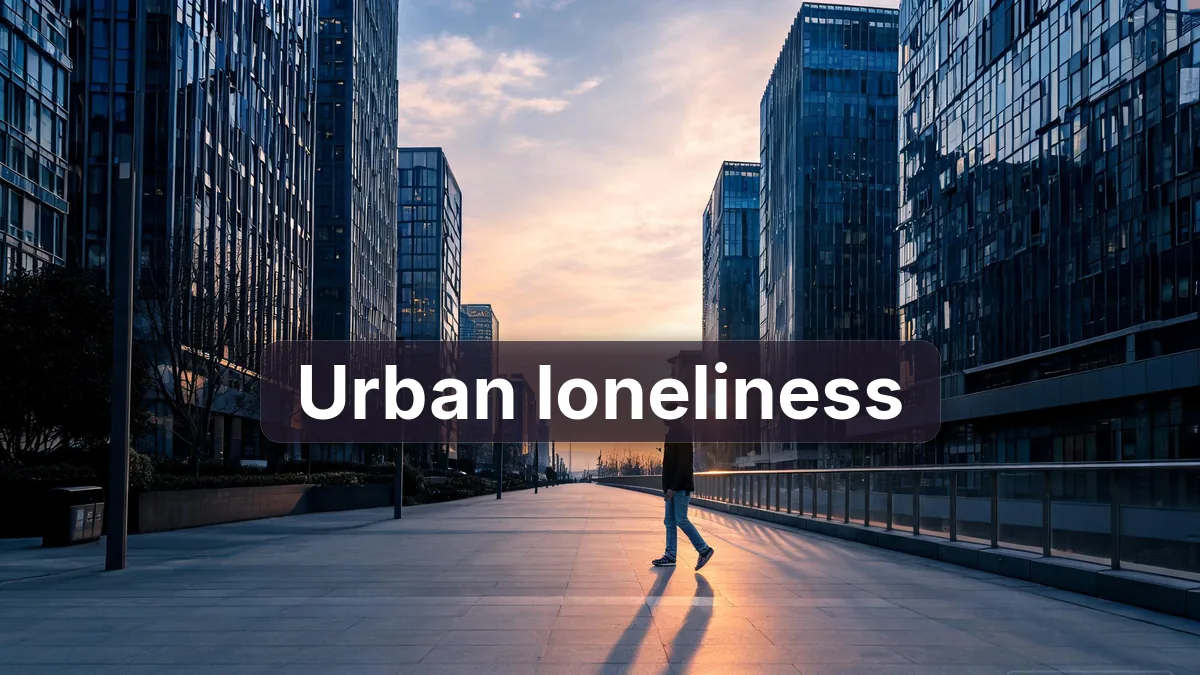
Urban loneliness is the paradox at the heart of modern city life: maximum physical density, minimum meaningful connection. Cities were built to generate the kind of casual, repeated contact that forms the basis of weak ties, Granovetter's term for the light social bonds with neighbors, shopkeepers, and acquaintances that research consistently links to wellbeing, employment, and community cohesion. The problem is that contemporary urban design and lifestyle increasingly removes the environments where weak ties form naturally, leaving residents surrounded by strangers in a way that their social architecture cannot process.
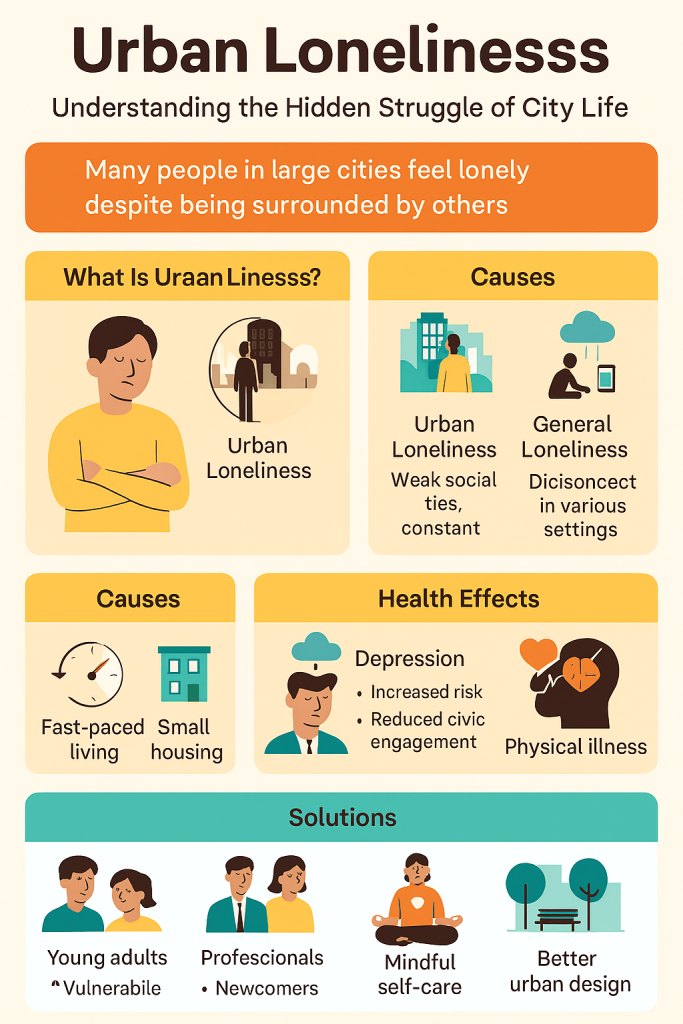
Living in a city can feel exciting, full of opportunity, and always busy. Yet, many people in large cities report feeling lonely. Urban loneliness describes the disconnect people often feel in crowded places where social ties may be weaker or harder to maintain. You can be surrounded by thousands of people, but still feel isolated.
This hidden struggle is more common than many realize. By looking at its causes, effects, and solutions, we can better understand how city life shapes human connection and what can be done to make urban living feel less isolating.
When I first moved to a big city, I thought the crowds would keep loneliness away. But within weeks, the bustle felt anonymous. I knew people’s names but didn’t feel close to anyone. Even in packed streets at night, I often felt invisible, proof that loneliness isn’t about being alone, but about lacking real connection.
Key Takeaways
- Urban loneliness is unique: Even in crowded cities, weak social ties and constant movement can leave people feeling isolated.
- City life fuels disconnection: Fast-paced living, small housing, and digital habits often reduce opportunities for real social bonds.
- Certain groups are more at risk: Young adults, professionals, newcomers, and older adults in cities are especially vulnerable to loneliness.
- Loneliness harms health and communities: It increases risks for depression, physical illness and lowers civic engagement.
- Solutions exist at both personal and community levels: Stronger relationships, community activities, mindful self-care, and better urban design can all help reduce loneliness.
What Is Urban Loneliness?
The anonymity effect in urban environments is well-documented: the larger and denser the population around you, the less social obligation each individual within it feels. In a village of 150 people, everyone notices when you are struggling. In a city of millions, the statistical probability that any individual will be noticed by any other specific individual approaches zero. This mathematical reality creates a loneliness context that is structurally different from rural isolation, not absence of people, but absence of the relational structures that give people meaning.
To understand urban loneliness better, it helps to look at its specific features and what makes it different from other types of loneliness. For a deeper explanation of loneliness and what it means, see loneliness meaning.
Defining Urban Loneliness
Urban loneliness is defined as the feeling of isolation or lack of connection despite living in densely populated areas.
Urban loneliness is a type of isolation experienced in cities. It happens when the environment creates barriers to forming or maintaining meaningful relationships, despite being physically close to others.
How It Differs from General Loneliness
Urban vs. General Loneliness
| Aspect | Urban Loneliness | General Loneliness |
| Causes | Fast pace, crowded housing, transient populations, digital disconnection | Life changes, family conflict, bereavement, lack of close friends |
| Groups Most Affected | Young adults moving for school/work, remote professionals, immigrants, elderly in cities | Older adults living alone, people with chronic illness, and those in rural isolation |
| Health Effects | Stress from overstimulation, a higher risk of anxiety and depression, and reduced civic engagement | Depression, heart disease, and weakened immunity, often linked to long-term isolation |
General loneliness can happen anywhere, in small towns, rural areas, or even within families. But urban loneliness happens because of city life factors like fast pace, crowded housing, and people moving often, which make it harder to form close, lasting connections.
Why Cities Increase Loneliness
Cities are often busy and noisy, with people rushing and competing, leaving little time for casual, friendly interactions. This can make people feel more alone even when surrounded by others.
Causes of Urban Loneliness

Many things about city life can make people feel lonely, so it’s a complicated problem that needs many different ideas and solutions.
The way cities are built, how people live and move around, and how technology changes communication all affect how connected or isolated people feel.
Many causes overlap with general loneliness; more details can be found on causes of loneliness.
High Population Density but Low Social Connection
Being surrounded by people doesn’t guarantee closeness. Many city residents feel anonymous, with limited meaningful interaction.
Even in busy neighborhoods, people often don’t know their neighbors, which makes it hard to build trust and friendships.
Fast-Paced and Competitive Environments
City life often prioritizes work and achievement, leaving less time for deep relationships.
The pressure to keep up with busy schedules means many people feel rushed and drained, missing chances to relax and connect with others.
Transient Populations and Short-Term Living
Students, professionals, and newcomers often stay only a few years, making stable friendships harder to form.
This constant change in residents can break community ties and make people feel like outsiders.
Housing Conditions: Small Apartments and Shared Spaces
Tight living arrangements can limit privacy while also reducing opportunities for genuine socializing.
Small homes and crowded buildings may feel confining, and a lack of common areas means fewer chances to meet people casually.
Technology and Digital Disconnection
Heavy reliance on phones and social media can reduce face-to-face interactions, even in shared public spaces. While technology helps us stay in touch, it can also replace real conversations with less satisfying virtual ones, increasing feelings of loneliness.
Who Is Most Affected?

Urban loneliness can affect many different groups of people, but some are more likely to feel isolated due to their life situations or challenges.
Young Adults and Students in Cities
Moving to a new city for school or work often means leaving behind friends and family. This can make young adults and students feel lonely as they try to adjust and build new connections.
If you want to learn more about the unique challenges students face, including causes, signs, and helpful strategies, check out our detailed guide on lonely students.
Working Professionals and Remote Workers
Long work hours and working from home can cut down on chances to socialize.
This makes it tough for professionals to keep strong friendships and feel part of a community. Workplace loneliness and its effects are covered further in lonely at work.
Immigrants and Newcomers
Living in a new place with different languages and customs can create barriers. Immigrants may find it hard to meet people and join local groups, increasing their loneliness.
Elderly Populations in Urban Settings
Older people may have trouble getting around or may live alone. These challenges can make them feel isolated, especially when family and friends are far away or busy.
The Effects of Urban Loneliness

Urban loneliness does more than make people feel sad; it affects their mental and physical health, work life, and how they connect with their communities. These effects can add up and cause serious problems if not addressed.
Mental Health Consequences
Prolonged loneliness is closely linked to higher rates of depression, anxiety, and stress.
Research shows that people who always feel lonely have over a 50% chance of experiencing depression, compared to less than 10% for those who never feel lonely.
Physical Health Risks
Studies show loneliness can increase risks of heart disease, weakened immunity, and even early mortality.
Workplace Productivity and Job Satisfaction
Disconnected workers may feel less motivated, which can lower performance and satisfaction.
Effects on Community and Civic Engagement
People who feel lonely are less likely to join community events or volunteer. This weakens neighborhood bonds and can make entire communities less supportive and vibrant.
Signs You Might Be Experiencing Urban Loneliness
Knowing the signs of urban loneliness can help you recognize it early and take steps to feel more connected.
These signs often show up in emotions, behavior, and how you feel around others. Learn more about common loneliness symptoms.
- Emotional and Behavioral Indicators:
Feelings of sadness, emptiness, or low motivation are common signs. You might also feel anxious or restless without knowing why.
- Social Withdrawal Despite Proximity to Others:
You may avoid social events or prefer staying home, even when chances to connect are available. This withdrawal often deepens the feeling of being alone.
- Feeling Invisible in Crowded Spaces:
Feeling like no one notices you, even in busy places, can be a strong sign of urban loneliness. It can make you feel isolated despite being surrounded by people.
Coping Strategies for Individuals
The most evidence-supported individual-level interventions for urban loneliness share a common structure: they create recurring, low-commitment contact with a consistent set of people. Regular exercise classes, volunteer roles, neighborhood associations, and recurring hobby groups all generate the repeated exposure that, over time, converts strangers into acquaintances and acquaintances into the weak ties that buffer against loneliness. The research is unambiguous: it is not the intensity of contact that matters most, but its consistency and its predictability.

When feeling lonely in a city, there are helpful ways to cope that can strengthen connections and improve well-being. These strategies focus on building meaningful relationships, staying involved, balancing online and offline life, and caring for yourself.
Building Deeper Social Connections
Focus on creating strong, meaningful relationships instead of many surface-level ones. Genuine bonds provide emotional support and help reduce feelings of loneliness over time.
Participating in Community Activities
Get involved in local clubs, events, or volunteer groups where you can meet people who share your interests. Being part of a community can create a sense of belonging and purpose.
Balancing Online and Offline Interactions
Use technology like video calls and social media to stay in touch when meeting face-to-face isn’t possible. However, make time for in-person meetings too, as real-life interactions help build stronger bonds.
Some find comfort in new ways like AI companions, learn What is an AI girlfriend to understand this growing form of support. Discover how AI girlfriend companions offer emotional support in a digital world.
Practicing Mindfulness and Self-Care
Taking care of your mental and physical health is key. Activities like exercise, journaling, or meditation help manage stress and can improve your overall mood and resilience.
Community and Policy Solutions
Cities and communities can help reduce loneliness by designing spaces and programs that bring people together and encourage social connections.
Urban Design for Social Connection
Cities can plan neighborhoods with shared spaces that encourage casual interaction.
Public Spaces That Encourage Interaction
Parks, plazas, and community centers help people meet and connect naturally.
Workplace and School Initiatives
Employers and schools can promote social activities, group projects, and wellness programs.
Government and NGO Programs Targeting Loneliness
Support networks, helplines, and outreach programs can help reduce isolation.
The Future of Cities and Connection

Cities are changing with new technology and ideas that can help people feel closer and more connected. These changes may make it easier to meet others and build community in busy urban areas.
- Smart cities use apps and websites to help neighbors share news, find local events, and connect more easily.
- The COVID-19 pandemic showed how important it is to have strong support nearby, encouraging more focus on local connections.
- Future cities will mix technology with thoughtful design to create places where meeting and connecting feel natural and easy.
Conclusion: Addressing Urban Loneliness Together
Urban loneliness is a growing problem in cities, where many people feel isolated even though they live surrounded by others. This happens because city life can make it hard to build close relationships, leaving people feeling disconnected and lonely.
The effects of urban loneliness go beyond feeling sad, it can harm mental and physical health, reduce job satisfaction, and weaken communities. However, by understanding the causes and recognizing the signs, individuals can take steps to feel more connected.
Communities and cities can also help by creating welcoming spaces, supporting social activities, and using technology to bring people together. With effort from everyone, urban loneliness can be reduced, making cities places where people truly feel they belong. For those looking for a safe space to connect and feel less alone, an AI girlfriend can offer compassionate conversation anytime.
What People Ask About Urban Loneliness
Why do cities feel so lonely?
Cities concentrate people while simultaneously removing the environmental conditions that generate natural social contact. High mobility (people move frequently), anonymous design (apartment buildings without shared spaces, streets optimized for cars rather than pedestrians), and time-compressed lifestyles (long commutes, demanding work schedules) all reduce the incidental contact that forms the substrate of social connection. The loneliness of cities is largely architectural and structural, a design problem, not a personal failing.
Is it normal to feel lonely after moving to a new city?
Yes, and research on social network formation suggests it takes most adults 3 to 6 months of consistent effort to establish a basic social network in a new location, and up to two years to build relationships of meaningful depth. The mistake people make is interpreting the early months of urban isolation as evidence of personal failure rather than as the expected timeline for connection formation in unfamiliar environments. If you are less than a year into a new city, you are in the middle of a normal process, not at the end of a failed one.
How do you meet people when you move to a new city?
Structured recurring activities consistently outperform one-off social events for forming lasting connections. A class, a sports league, a volunteer shift, a book club, anything that puts you in repeated contact with the same set of people around a shared activity is more effective than bars, apps, or networking events. The mechanism is the mere exposure effect: repeated contact creates familiarity, familiarity creates comfort, and comfort creates the conditions for genuine connection.
Do cities have higher rates of loneliness than rural areas?
The data is more nuanced than the intuition. Urban areas do report higher rates of loneliness in some surveys, but rural areas show higher rates of severe isolation, particularly among elderly populations with limited mobility. Suburban environments show their own distinct loneliness profile, driven by car-dependency and low-density design that reduces walkable social contact. Loneliness is not primarily a function of population density; it is a function of whether the environment generates meaningful relational contact, regardless of how many bodies are nearby.
What are the best cities in the world for social connection?
Cities that consistently rank highest for social wellbeing share several features: walkable neighborhoods that generate incidental contact, robust public spaces (parks, squares, markets), strong civic participation culture, and affordable enough housing that diverse communities remain stable over time rather than being displaced every few years. Amsterdam, Copenhagen, and Vienna consistently rank among the highest; Tokyo, despite its scale, maintains strong neighborhood-level community structures that buffer urban anonymity in ways that many Western cities do not.
Disclaimer
This article is for informational purposes only and does not provide medical advice. If you are struggling with loneliness, depression, or related mental health concerns, please reach out to a qualified healthcare professional or counselor for support.