

Cosplay is dressing up as a character you love from anime, games, comics, movies, or TV, and acting like them too. The word is a mash-up of "costume" and "play." A Japanese journalist named Nobuyuki Takahashi made it up in 1984, writing it as コスプレ (kosupure). At its heart, cosplay is three things at once: making (or buying) a costume, playing the character, and a community that loves the same stuff you do.
Key Takeaways
- Cosplay means dressing as (and acting like) one specific character, not just wearing any old costume.
- The word was coined in 1984 by Japanese journalist Nobuyuki Takahashi after he saw fans in amazing costumes at Worldcon in Los Angeles.
- It blew up through Japanese anime fans and Comiket in the 1990s, then went worldwide thanks to Comic-Con and the internet.
- Cosplay is a craft, a performance, and a scene with its own rules. The biggest one: "cosplay is not consent."
| Pronunciation | KOS-play (コスプレ), noun and verb |
|---|---|
| Coined by | Nobuyuki Takahashi (高橋信之), Japanese journalist |
| Year coined | 1984 in Japan; common in English by the mid-1990s |
| Origin event | Worldcon 1984, Los Angeles |
| Category | Hobby and fan practice |
| Core trait | Dressing as and playing a specific fictional character |
| Related practices | LARP, masquerade, historical reenactment, drag |
Etymology and Origin
"Cosplay" is two English words, costume and play, smushed together. Funny thing: the smushing happened in Japan first, then came back to English. We have Nobuyuki Takahashi (高橋信之) to thank, a journalist and editor at My Anime magazine. In 1984 he flew to the 42nd World Science Fiction Convention (Worldcon) in Los Angeles. Watching American fans show up in wild, hand-built sci-fi outfits, he wanted a punchier word than the older Japanese term kasou (仮装, "masquerade"). So he mashed "costume" and "play" into コスプレ (kosupure) and used it in an article back home.
The timing was perfect. Japanese anime and manga fandom was about to take off, and Comiket, the giant Tokyo fan-comic fair, was becoming a magnet for fans in costume. By the early 1990s, kosupure was the standard word in Japan. By the mid-1990s, "cosplay" had hopped back to English, brought along by Western fans who picked up both the practice and the name. What started as journalist shorthand became the global word for an entire scene.

Defining Elements of Cosplay
- A specific character: the costume is one named character you can point to, not a generic "witch" or "knight."
- Playing the character: cosplayers pick up the way their character stands, moves, and poses.
- Hand-made craft: sewing, prop-building, wigs, makeup, and armor work, often built over weeks or months at the kitchen table.
- Convention culture: cosplay lives at cons, masquerade contests, and meetups where the costumes get to come out and play.
- Photos and sharing: photo shoots and online posts aren't a bonus, they're part of the whole point.
- Community love: fellow fans cheer for "screen-accurate" builds and creative twists alike.
- A bit of performance: at masquerades and contests, on-stage skits and posing routines turn the costume into a mini-show.
How to Recognize Cosplay (in the Wild)
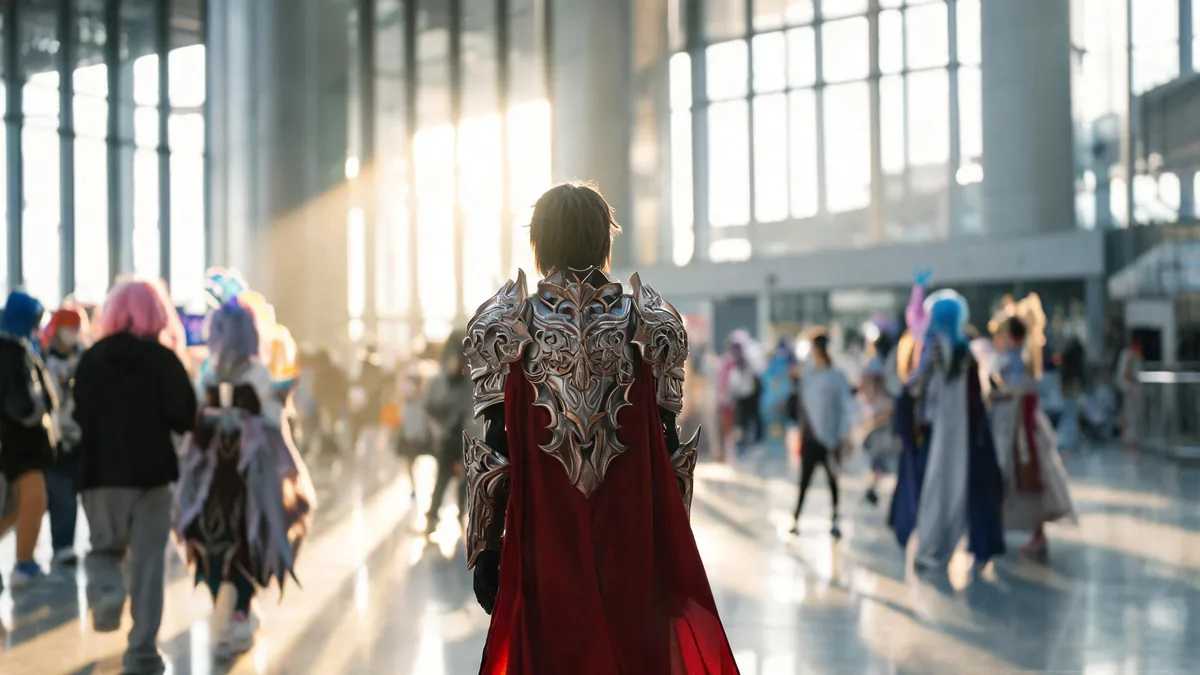
At a glance, cosplay can look like any old costume. But there are little tells once you know what to look for:
- The outfit is one specific named character, often with tiny details only fans of the source would catch.
- Hand-built or customized stuff: hand-sewn fabric, foam-and-resin props, custom-styled wigs, fancy armor.
- Pose work. The cosplayer drops into the character's signature stance the moment a camera comes out.
- A little care kit in their bag: safety pins, makeup touch-ups, tape, a folding fan for heavy costumes.
- Coordinated groups, where friends cosplay as the rest of the cast, party, or team from the same source.
- Casual chat about "the build," "the photoshoot," and "the con," the three pillars of cosplay life.
- Polite photo manners: asking before snapping a picture, posing on request, and respecting "cosplay is not consent."
If the costume looks home-built, the wearer flips into character on camera, and there's a friend nearby with a big lens, you're almost certainly watching cosplay.
How Cosplayers Talk About Their Craft
Cosplay has its own everyday slang, and you can hear the scene in the way cosplayers describe what they do:
- "I'm building a Saber cosplay for Anime Expo. The armor is going to take me months."
- "This is my first competition cosplay. I'm entering the masquerade."
- "We're doing a group cosplay this year, the whole party from the game."
- "Photo's fine, but please ask first. Cosplay is not consent."
The shared lingo tells you cosplay is treated as a craft and a community, not a one-off Halloween outfit. The same words travel from cons to TikTok to Discord servers without changing much at all.
How Cosplay Evolved
The thing itself is older than the word. People usually point to the very first Worldcon in 1939 as the earliest "proto-cosplay" moment, when Forrest J. Ackerman and Myrtle R. Douglas showed up in matching futuristic outfits inspired by the movie Things to Come. Costumed fans kept popping up at sci-fi cons over the next few decades, but the practice didn't have a snappy name until Takahashi coined kosupure in 1984.
After that, things moved fast. The 1990s were the big Japanese boom, powered by Comiket and the anime wave. The 2000s took cosplay global through Akihabara culture, San Diego Comic-Con, Anime Expo, and early online hubs like cosplay.com. The 2010s turned the best cosplayers into social-media stars on deviantArt, Tumblr, and Instagram, and built a small but real cosplay celebrity scene. The 2020s spread it across TikTok, Twitch streams, in-person cons, and virtual ones, while pop culture finally accepted cosplay as a totally normal thing to be into.
Types of Cosplay
By source material
- Anime and manga cosplay: the original 1990s wave, still the biggest category at most cons. Think Sailor Moon to Demon Slayer.
- Western pop-culture cosplay: comic-book heroes, video-game characters, big movie and TV faces. Think San Diego Comic-Con and Dragon Con.
- Original character (OC) cosplay: a character the cosplayer designed themselves, usually based on a genre rather than one source, often with a backstory to match.
By style and approach
- Casual cosplay: simpler, easy-to-wear outfits, sometimes a mash-up of streetwear and signature character bits (the classic "Starbucks Sailor Moon").
- Competition cosplay: super-detailed, hand-crafted builds made for masquerades and championships.
- Crossplay: cosplaying a character of a different gender than your own.
- Crossover cosplay: blending two characters or universes, like a Hogwarts-uniform Jedi.
Famous Cosplayers and Iconic Moments
- Yaya Han: pioneer, contest judge, and fabric-line entrepreneur. She helped turn cosplay into a real professional craft.
- Jessica Nigri: one of the most recognized convention cosplayers, a fixture of the modern Comic-Con era.
- Riki "Riddle" Lecotey: a community leader known for her armor builds and the TV show Heroes of Cosplay.
- Worldcon 1939: Forrest J. Ackerman and Myrtle R. Douglas show up in costume, the moment now treated as proto-cosplay.
- Comiket in the late 1980s: the Tokyo fan-comic fair where kosupure went from a journalist's word to a real scene.
- San Diego Comic-Con cosplay parades: the yearly viral photo sets that shaped how everyone pictures the practice.
Cosplay in Conventions and Online Culture
Cosplay is glued to the places it happens. The biggest in-person hubs are San Diego Comic-Con, Anime Expo, Dragon Con, New York Comic Con, and Comiket, plus a long list of regional cons. Each has masquerade contests, photo-shoot zones, and a stack of unwritten rules. Online, cosplay lives wherever fans hang out:
- Instagram and TikTok for short costume reveals, transformations, and trending audio routines.
- Twitch streams where cosplayers chat in full costume between matches or art streams.
- Photographer-driven sites that treat cosplay photography as its own art form.
- Discord servers, subreddits, and forums where builds get workshopped from sketch to finished armor.
- Virtual cons and online masquerades that started in 2020 and stuck around for folks who can't travel.
Cosplay vs Related Practices
Cosplay overlaps with a few other costumed practices, but each one has its own backstory and focus.
| Practice | Origin | Distinction |
|---|---|---|
| Cosplay | Japan, 1984 | Playing a specific fictional character through costume, performance, and community. |
| Costume play (general) | Historical, pre-1984 | Wearing a costume without necessarily becoming a particular character. |
| LARP (Live Action Role-Play) | Late 1970s, from tabletop RPGs | You play a character inside a real interactive story, not just a look. |
| Masquerade | Centuries-old European tradition | Anonymous costumed party, usually not tied to a named character. |
| Historical reenactment | 19th- and 20th-century hobbyists | Recreates real history or battles, not fictional characters. |
Is Cosplay Just Dressing Up?
Not quite. It's three things at once: making (or buying) a costume, playing the character, and being part of a community. Plenty of cosplayers sew their own outfits, build their own props, and head to cons with friends. Calling it "just dressing up" misses the part that matters most to the people who do it. Cosplay is a creative practice with shared rules, a competitive craft side, and clear manners, including the much-repeated line that "cosplay is not consent." A fancy costume is never an invitation for unwanted attention or touching.
The Appeal (and the Nuance)
Why people love it: cosplay rewards every kind of creativity at once. You can spend months sewing and prop-building, sharpen an eye for photography, perform on a masquerade stage, and meet friends who love the same stories you do. It's also a low-pressure way to try on confidence, gender presentation, or a totally different vibe inside the safety of a character. First-timers are often surprised by how much courage the costume gives them.
The nuance: cosplay runs on respect. Con culture leans hard on consent for photos and touch, on respecting people's bodies no matter how skimpy a costume is, and on being kind to newer cosplayers whose builds are still rough. "Cosplay is not consent" is the short version. The scene works best when people treat it as a craft and a community, not a spectacle to grab at. The strongest scenes are the ones with the clearest rules.
Cosplay in AI Companions
Cosplay slides naturally into the world of AI companions. The same itch (playing with the look and feel of a favorite character) can be scratched without months of sewing and prop-building. An AI companion built around a cosplay theme can take on a specific look, a recognizable vibe, and a personality that matches the costume. If the idea of a partner who shows up in your favorite styles sounds fun, check out our Cosplay AI girlfriend collection, or create an AI girlfriend from scratch with the wardrobe, look, and personality you want.
Frequently Asked Questions
What does cosplay mean?▾
Cosplay means dressing up as one specific character (usually from anime, manga, comics, games, or movies) and acting like them too. The word is a mash-up of 'costume' and 'play.'
Who invented the word cosplay?▾
A Japanese journalist named Nobuyuki Takahashi (高橋信之) came up with コスプレ (kosupure) in a 1984 article, after seeing fans in amazing costumes at Worldcon in Los Angeles. The word crossed back into English by the mid-1990s.
Is cosplay only for anime?▾
Nope. Anime and manga are the biggest category at most cons, but cosplay covers comics, video games, movies, TV, and made-up original characters too.
What's the difference between cosplay and LARP?▾
Cosplay is mostly about the costume, the look, and quick in-character poses, usually for photos and conventions. LARP (Live Action Role-Play) means actually playing a character inside a live, interactive story with other players.
Do you need to make your own cosplay?▾
Not at all. Lots of cosplayers build their own costumes, but you can also hire a maker, buy a ready-made outfit, or piece something together from thrift finds. All of it counts.
What does 'cosplay is not consent' mean?▾
It's the golden rule of convention culture: wearing a costume, no matter how revealing or accurate, is never an invitation for unwanted photos, touching, or sexual attention. Always ask before taking a photo, and respect a 'no.'
Can men cosplay female characters?▾
Yes. Cosplaying a character of a different gender than your own is called crossplay, and it's a totally normal, welcomed part of the scene.
Where can I see cosplay in person?▾
The biggest hubs are San Diego Comic-Con, New York Comic Con, Anime Expo, Dragon Con, and Comiket in Tokyo. You'll also find regional anime cons, gaming expos, and local meetups pretty much everywhere.
Meet our cosplay AI girlfriends
Browse the companions on AIGirlfriends.ai who play this archetype with conviction.
Cosplay AI Girlfriend →