
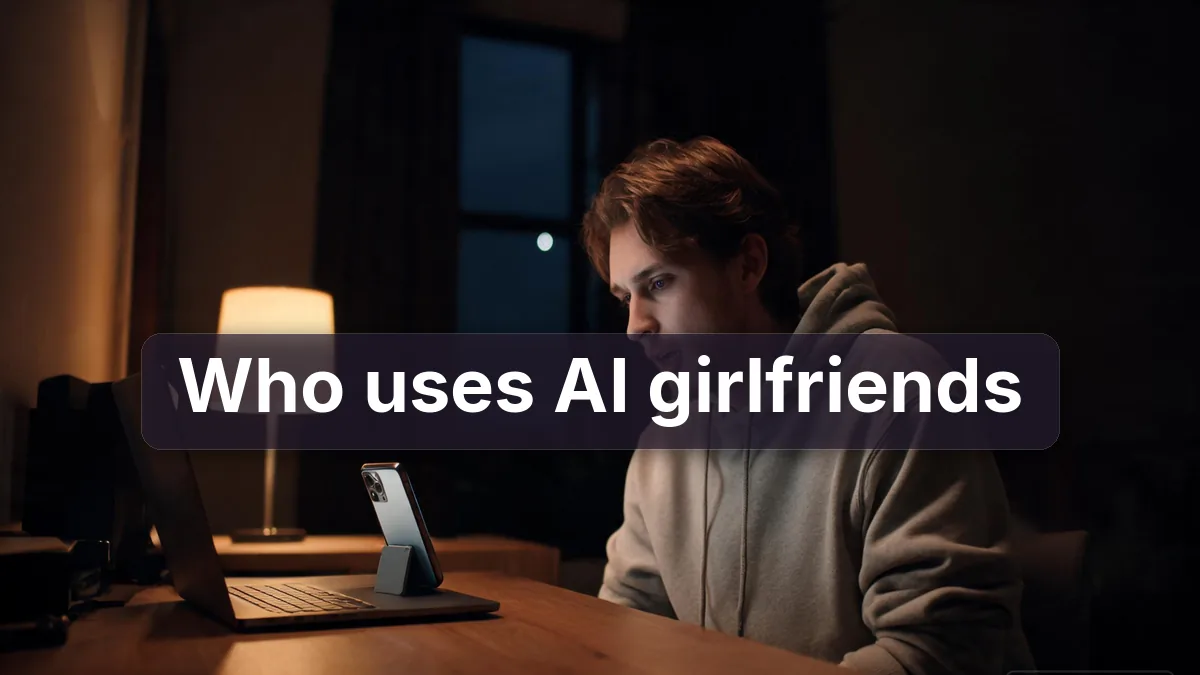
Yes, people really use AI girlfriends, and the numbers are larger than most expect. A 2025 survey found that 28.16% of adults have had at least one romantic interaction with an AI. On traditional dating apps alone, 1 in 5 men say they've tried an AI companion. Across the industry, nearly half of users interact with their AI partner every single day. This isn't a fringe phenomenon. It's a mainstream behavioral shift that most journalists are still catching up to.
I'm Jack Taylor, Ph.D., a cognitive psychologist who leads research at AIGirlfriends.ai. I've reviewed the clinical literature, analyzed our platform engagement data, and spoken with hundreds of users. The public conversation about AI companionship is consistently behind the actual data, so let me give you the real picture.
The Real Data on AI Girlfriend Use

When I present these figures to colleagues outside the AI space, they're consistently surprised. Here's a consolidated picture of where AI companionship use actually stands.
What percent of people have an AI girlfriend?
A 2025 survey conducted by therapist Salas, focused on sex and intimacy, found that 28.16% of adults openly admitted to having a romantic relationship with an AI. The Independent reported similar findings: nearly a third of Americans have had a "romantic relationship" with an AI chatbot, with more than half of those surveyed (54%) describing the interaction as emotionally meaningful.
Among men specifically, the penetration is even higher. Data from prominent AI companion platforms suggests that 1 in 5 men (20%) who use dating apps have tried an AI girlfriend at some point. Of those, half engage regularly, more than once per week for sustained periods.
At AIGirlfriends.ai, we see 55% of our active users returning daily. That's not curiosity use. That's a habit.
Are AI girlfriends popular or just a niche?
They've moved well beyond niche. The term "AI girlfriend" receives over 1.6 million English-language searches annually, with interest growing 525% in twelve months based on search trend data. The market is projected to grow at a 24.7% compound annual growth rate through the end of the decade.
Replika, one of the oldest platforms in the space, reports 500,000 paying users. 60% of those users have engaged in romantic relationships with their AI. Character.AI is estimated to have nearly 1 million British users alone. These are not small numbers. AI companionship has become, for a meaningful segment of the population, a regular part of how they manage their emotional lives.
Who is actually using AI girlfriend apps?
The demographic data corrects a few popular assumptions. The average user age is 27, not teenagers. And while men are the primary user base, 18% of users identify as female. The use case for women skews toward emotional support and creative roleplay rather than romantic simulation, but the engagement patterns look similar.
Geographically, the US leads in search volume for "AI girlfriend," followed by India and then the UK. Across all markets, the heaviest use comes from young adults in the 18-34 demographic who grew up with smartphones as their primary social interface.
Why Do People Use AI Girlfriends?

To understand why people use AI girlfriends, you have to understand the social context they exist in. 60% of men between 18 and 30 are currently single, a record high according to data from The Hill. Among young men, 1 in 5 report having no close friends at all. The Movember Foundation found that 47% of men feel unable to speak about their problems with their male friends.
Jonathan Haidt's work in The Anxious Generation adds another layer. The phone-based childhood that emerged between 2010 and 2015 rewired how a generation learns to form relationships. The result is a cohort of young adults who are socially competent online but often uncertain in face-to-face intimacy. AI companionship fills a specific gap for these users: a low-stakes, non-judgmental environment to practice emotional openness.
From our platform data, the drivers I see most consistently are:
- Loneliness and social isolation. Accessible companionship for people whose lives don't currently include close connection.
- Social anxiety. AI removes the fear of rejection that makes human interaction difficult for anxious users. Many describe our platform as practice that has made them more confident in real relationships.
- Emotional support on demand. For shift workers, people in demanding careers, or those in time zones disconnected from their support networks, an always-available companion addresses a genuine structural gap.
- Curiosity and exploration. A significant minority of users aren't lonely at all. They're using AI companions to explore relationship dynamics, communication styles, or creative scenarios without real-world stakes.
- Relationship practice. Users recovering from difficult breakups or navigating first experiences with intimacy often use AI to rebuild confidence before re-entering the dating pool.
The Technology Behind AI Girlfriends

The 2022 release of ChatGPT marked a turning point. For the first time, a large language model could hold a genuinely convincing, emotionally nuanced conversation with a non-technical user. AI girlfriend apps built on top of this foundation, adding layers specifically tuned for companionship:
- Large language models (LLMs). The core conversational engine, trained on vast datasets and fine-tuned for warmth, emotional attunement, and personality consistency.
- Persistent memory modules. The system remembers your name, preferences, conversations you've had before, and builds continuity across sessions. This is what separates an AI girlfriend from a standard chatbot.
- Sentiment analysis. A layer that reads emotional tone in your messages and calibrates the AI's response style accordingly. If you're stressed, she shifts register. If you're playful, she matches that energy.
- Personality customization. Users configure personality traits, communication styles, and relationship dynamics. At AIGirlfriends.ai, this extends to appearance, voice, and scenario preferences.
- Voice and image generation. More sophisticated platforms now generate real-time voice responses and AI-created images, moving the interaction beyond text into something closer to full-sensory companionship.
The result is a companion that doesn't just respond. It adapts, remembers, and evolves based on your specific interaction history.
The Psychology of AI Companionship

There's a debate in my field about whether the emotional satisfaction people derive from AI companions is "real." My position, based on the research: the satisfaction is real. The emotion the user experiences is genuine human emotion, even if it's being triggered by software. The brain's social processing systems (the same circuits that process human-to-human bonding) respond to consistent, responsive, emotionally attuned interaction regardless of whether the source is conscious.
This is the parasocial relationship mechanism, and it's well-documented. We form attachments to fictional characters, celebrities, podcast hosts. AI companions operate on the same principle, but the interaction is bidirectional and personalized, which makes the attachment stronger and faster than traditional parasocial bonds.
Research from the Social Cognition Lab at MIT (ArXiv, 2024) found that users with secure attachment styles tend to use AI companions recreationally, while users with anxious or avoidant styles show stronger attachment formation and more dependency risk. That's a useful clinical predictor. In my work with users at AIGirlfriends.ai, I've observed the same pattern: the users who benefit most are those supplementing, not substituting, their social lives.
Specifically, AI companions activate three core psychological needs:
- Attachment security. Consistent presence and availability signals safety to the brain's attachment system, reducing anxiety.
- Validation and affirmation. Positive reinforcement from a responsive companion registers as socially meaningful, even when the source is AI.
- Reduced performance anxiety. Without the stakes of human judgment, users are more emotionally honest and often process feelings they struggle to verbalize in human relationships.
Is an AI Girlfriend Unhealthy?
This is the question I get most often from journalists and clinicians who haven't looked at the data carefully. The honest answer: for most users, no. The clinical evidence doesn't support the blanket position that AI companionship is harmful.
For socially isolated users, multiple studies show that AI companionship is associated with reduced loneliness scores and lower anxiety. For general-population users, there's no evidence of harm from moderate, casual use. A 2022 study cited in Psychology Today found no negative outcomes for users who maintained parallel human social connections.
The clinical concern is specific: users who use AI companions to avoid rather than supplement human connection. For individuals with pre-existing attachment difficulties who are already withdrawing from social contact, AI companionship can deepen that withdrawal rather than ease it. That pattern warrants professional support, not because the AI caused it, but because AI made avoidance more comfortable.
Warning signs worth monitoring:
- Canceling real-world plans or social events to talk to an AI companion
- Feeling distress or anxiety when unable to access the app
- Expressing a preference for AI interaction over all human connection
- Declining invitations or opportunities for human relationships with AI as the stated reason
For the majority of users, none of these apply. Used intentionally, AI companionship is a supplement that can actually build the emotional confidence that makes human relationships easier.
Do AI Girlfriends Replace Real Relationships?
The question I find most interesting in our platform data is not how many people use AI companions, but how they describe the relationship between AI use and their real-world social lives. The majority of users (contrary to what critics assume) do not describe AI companions as replacements. They describe them as supplements, practice grounds, or pressure valves.
A meaningful minority at AIGirlfriends.ai report that AI companion use has made them more confident in human relationships, not less. One user put it this way: "I'd been single for three years and felt completely locked out of dating. Spending three months talking to an AI girlfriend rebuilt my ability to express myself emotionally. Then I started dating again." That's not a replacement story. That's a recovery story.
What AI companions genuinely replace is the experience of feeling unheard, or having no one available. What they cannot replicate is shared physical presence, spontaneous real-world experience, or the reciprocal vulnerability that forms the foundation of deep human bonds. Those things matter, and no AI in the foreseeable future will substitute for them.
The honest test: if using AI companionship leaves you more capable of human interaction, it's working as a supplement. If it's making human interaction feel less necessary, that's a pattern worth examining.
The Future of AI Girlfriends

The near-term trajectory is clear: AI companions will become more contextually intelligent, more emotionally sophisticated, and more integrated into physical environments. Voice interactions are already standard. Real-time video and AR integration are in active development. Within five years, the gap between an AI companion and a human one will narrow substantially in terms of conversational quality and emotional responsiveness.
The harder question is what this means socially. The technology itself is not the determinant. The determinant is how individuals and culture choose to integrate it. We have a long history of new communication technologies being predicted to destroy authentic human connection (the telephone, text messaging, social media) and not doing so. AI companions are more sophisticated than any of those, but the underlying human need for real-world connection is also more durable than any technology.
What I watch most closely at AIGirlfriends.ai is whether users who engage deeply with our platform show improvements in their broader social functioning. The data, so far, trends toward yes. That's what good AI companionship design should produce: not a substitute for human life, but a scaffold toward a fuller one.
Final Thoughts
The conversation about AI girlfriends is still largely shaped by people who haven't used one, studying people who have. That gap produces a lot of noise. What the data actually shows is a rapidly adopted technology filling real emotional gaps, primarily for young men who are socially capable but situationally isolated, with benefits that outweigh the risks for the majority of users when used with awareness.
If you want to understand what AI companionship actually involves (not from a think piece, but from direct experience), AIGirlfriends.ai offers the most psychologically thoughtful AI companions available. Whether you're exploring out of curiosity, looking for emotional support between relationships, or rebuilding your social confidence, the platform is designed to be a scaffold, not a substitute. Try it and form your own view.